Peter Krakue is the founder of Strong Credit Report in Colton, California, where he has worked in consumer credit since 1999. He writes about dispute procedures, FCRA rights, and credit rebuilding. [Read more about Peter →]
Your credit score decides more about your financial life than almost any other three-digit number you’ll ever carry. It shapes whether a lender approves your mortgage, how much interest you pay on a car loan, and sometimes whether a landlord hands you the keys. Yet most people can’t say exactly what counts as a "good" score or how far theirs sits from the next tier.
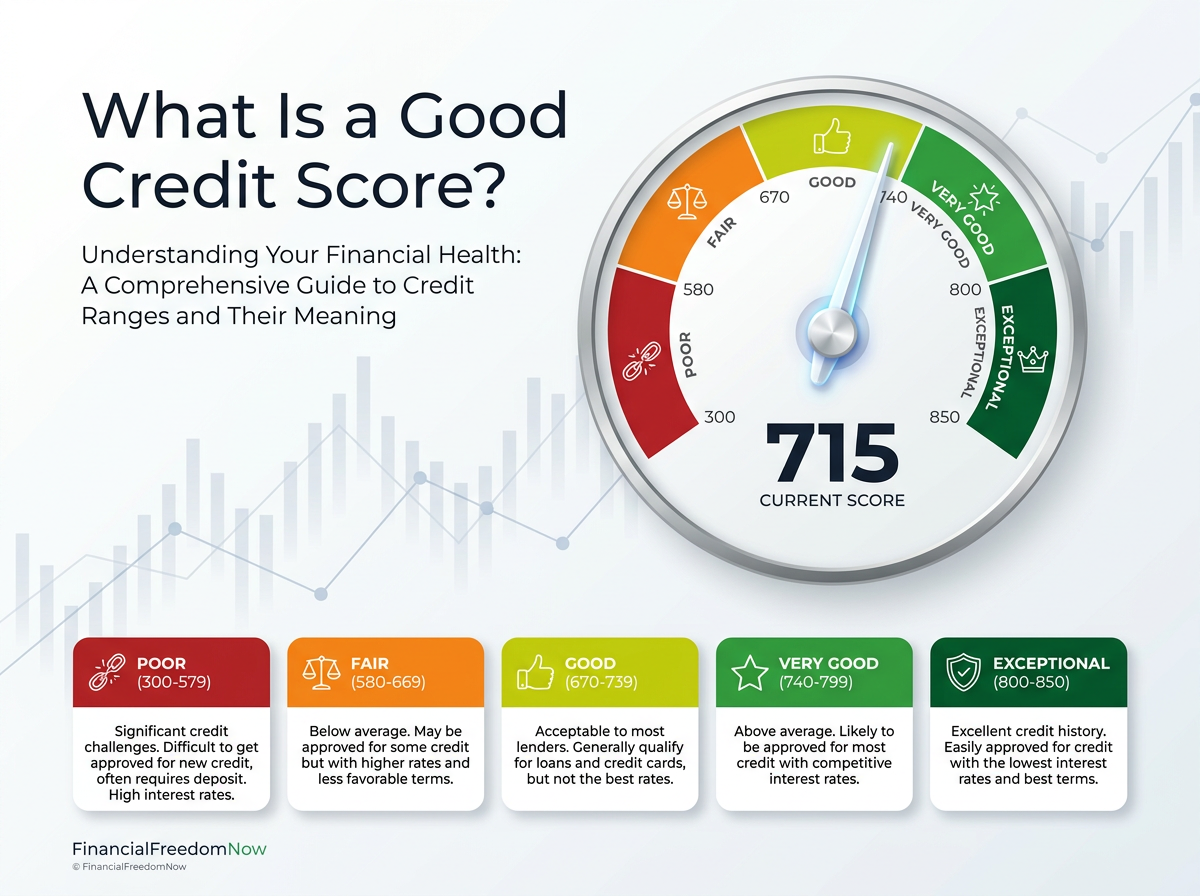
A good credit score is a FICO score of 670 or higher, or a VantageScore of 661 or higher — the threshold where lenders start treating you as a low-risk borrower and offering better terms, according to Fair Isaac Corporation. Below you’ll find the full ranges, the five factors that move your number, what lenders actually check, how to see your score for free, and a step-by-step plan to raise it.
Credit Score Ranges Explained
Credit score ranges are the labeled tiers lenders use to sort borrowers by risk. Each tier maps to a band on the 300–850 scale, and each signals a different level of borrowing power.
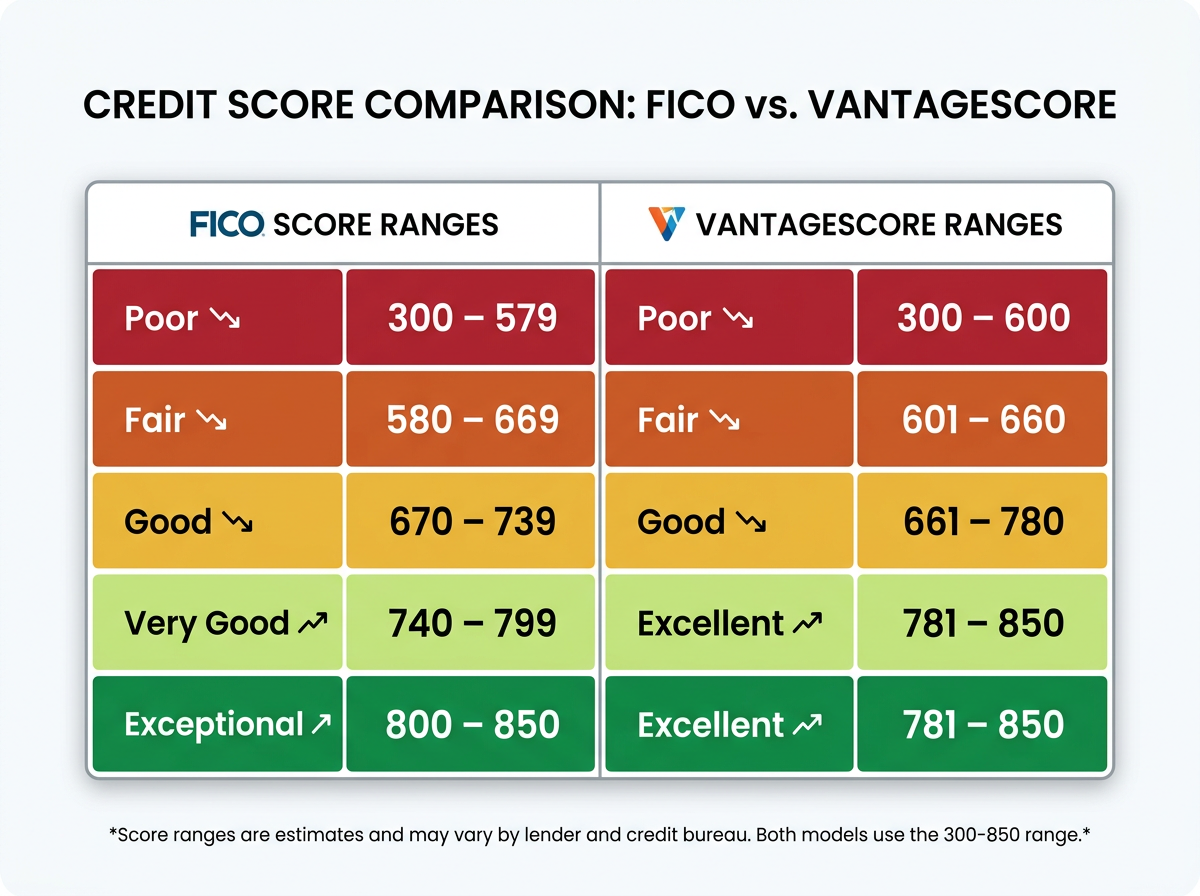
FICO and VantageScore both use 300–850 but draw their lines differently. Here they are side by side.
| FICO tier | FICO range | VantageScore tier | VantageScore range |
|---|---|---|---|
| Poor | 300–579 | Very Poor | 300–499 |
| Fair | 580–669 | Poor | 500–600 |
| Good | 670–739 | Fair | 601–660 |
| Very Good | 740–799 | Good | 661–780 |
| Exceptional | 800–850 | Excellent | 781–850 |
The tiers read in rows, not across — the two models don’t line up. VantageScore’s "Good" band starts at 661 rather than 670 and runs all the way to 780, covering territory FICO splits between Good and Very Good. That’s one reason your two scores can differ even when both pull from the same report.
What Each Tier Actually Gets You
| Tier | What approval looks like | What it costs you |
|---|---|---|
| Poor (300–579) | Often declined; deposits or a co-signer required | Highest rates where approved; secured products only |
| Fair (580–669) | Approvals possible — this is subprime territory | Noticeably higher rates and lower limits |
| Good (670–739) | Approvals become routine | Competitive rates; the typical borrower sits here |
| Very Good (740–799) | Strong approval odds across products | Better-than-average rates; best mortgage pricing starts here |
| Exceptional (800–850) | Highest approval odds | The best terms available |
Where the average sits
FICO publishes the national average score periodically. It stood at 717 in April 2024, 715 in April 2025, and around 714 as of its March 2026 release. The declines in 2024 and 2025 were driven partly by the resumption of federal student loan delinquency reporting — and they broke a long run of annual increases, with Experian recording the first annual decline since 2013.
That puts the typical American just inside the Good band, and it means "average" is not the same as "comfortable." The best mortgage pricing starts around 740, well above where most people sit.
Why the two models disagree
The models weigh your data slightly differently, so seeing different numbers is normal rather than a sign something is wrong. Two structural differences explain most of it:
- FICO needs more history. It requires at least one account open six months or more, plus one account reported in the last six months, before it can score you at all.
- VantageScore needs less. It can generate a score with as little as one month of history, which is why people newer to credit often see a VantageScore first.
Neither number is wrong. They’re two lenses on the same financial behavior.
Your next step: Pull one score from each model and note which tier each falls into. That comparison tells you how much room you have before the next threshold.
Why Your Credit Score Matters
Your score directly controls what it costs you to borrow. Over the life of a mortgage or auto loan, the difference between tiers runs into tens of thousands of dollars.
Example, using illustrative rates as of Q3 2026: on a $300,000 30-year fixed mortgage, a borrower at 760 or above might secure a rate near 6.5% — about $1,896 a month in principal and interest. A borrower at 640 paying 8% would owe about $2,201. That is roughly $305 more per month, and close to $110,000 in additional interest across 30 years. Same house, same loan amount, different score.
The impact reaches beyond loans:
- Auto loans. The APR gap between the top and bottom tiers can run ten percentage points or more.
- Credit cards. Better scores earn premium cards with rewards, higher limits, and lower interest.
- Apartment rentals. Many landlords run credit checks, and a low score can cost you the unit or force a larger deposit.
- Insurance premiums. In most states, insurers use credit-based insurance scores to set auto and home premiums.
- Utility and phone accounts. Some providers require a deposit if your score is low.
- Employment screening. Certain employers, especially in finance, review a modified credit report during hiring — with your written permission.
A strong score isn’t about vanity. It’s about keeping money in your pocket and doors open when you need them.
The Five Factors That Affect Your Credit Score
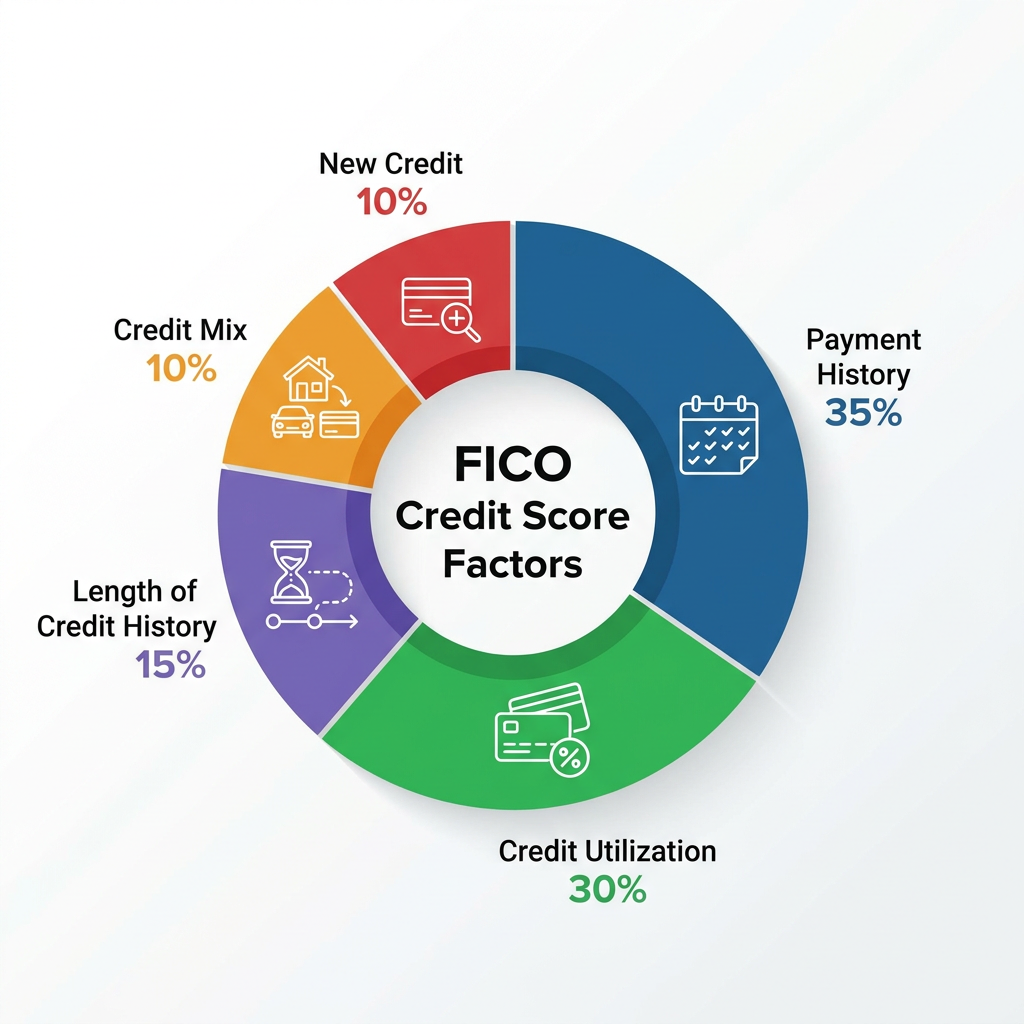
Five factors determine your FICO score, each with a fixed weight. Knowing the weights tells you where to focus first.
VantageScore uses similar inputs but describes their influence in ranked terms rather than fixed percentages — payment history as "extremely influential," credit utilization as "highly influential." The practical takeaway is identical: pay on time and keep balances low, and you’ve addressed 65% of what drives your score.
| Factor | Weight | What it measures |
|---|---|---|
| Payment history | 35% | Whether you pay on time — the largest factor by a wide margin |
| Amounts owed | 30% | How much you owe relative to your limits; utilization is the largest component |
| Length of credit history | 15% | Age of your oldest and newest accounts, and the average of all |
| Credit mix | 10% | Whether you manage both revolving and installment credit |
| New credit | 10% | Recent accounts and hard inquiries |
1. Payment history (35%)
The record of whether you’ve paid your accounts on time, and the single largest factor. How much one late payment costs depends on where your score started — FICO’s published example showed a 780 score dropping 90 to 110 points from a single 30-day late, and a 680 score dropping 60 to 80.
This category logs on-time payments, late payments, collections, bankruptcies, and foreclosures across every credit account you hold. An individual late payment stays for seven years from the date of that specific missed payment, though its damage fades well before then.
Your next step: Set every account to autopay for at least the minimum, then pay the full balance manually.
2. Credit utilization (30% category)
Utilization is the percentage of your available revolving credit you’re currently using — total card balances divided by total limits. It sits inside the amounts owed category and is its largest component.
Example: two cards with a combined $10,000 limit and $3,000 in balances is 30% utilization.
Keep it below 30%, and under 10% for the highest scores. This factor updates fast — pay down a balance today and your score can reflect it within one billing cycle. It’s calculated both per card and across all cards, so a single maxed-out card can hurt you even when your overall ratio looks fine.
Your next step: Pay your balance before the statement closing date, not just the due date, so a lower number gets reported.
3. Length of credit history (15%)
FICO looks at the age of your oldest account, the age of your newest, and the average age of all of them. A longer track record gives lenders more data to judge you on.
This is why closing an old credit card backfires: you shorten your average account age and lose the available credit that account contributed to your utilization. You can’t rush this factor — time does the work.
Your next step: Keep your oldest card open and active with a small recurring charge paid off monthly.
4. Credit mix (10%)
The variety of credit types you manage — revolving (cards and lines of credit) and installment (auto loans, mortgages, student loans). Handling both without missing payments demonstrates broader competence than a single card.
Never open a loan you don’t need just to diversify. This is the smallest lever alongside new credit, and unnecessary interest costs more than the factor returns.
Your next step: Check which types you already have, then let mix improve naturally — a first auto loan or mortgage adds it for you.
5. New credit (10%)
Tracks how many new accounts you’ve opened and how many hard inquiries you’ve triggered recently. A hard inquiry costs most people fewer than five points, stays visible for two years, and stops affecting your score after 12 months.
Opening several accounts in a short window signals risk. FICO does account for rate shopping: multiple inquiries for the same loan type within a 14-to-45-day window count as a single inquiry for scoring purposes — though they still appear individually on your report. Soft inquiries, like checking your own score, never affect it.
Your next step: Before applying, space out applications and confirm whether the check will be a hard or soft pull.
What Lenders Look For Beyond Your Score
Your score answers "how have you handled credit?" These additional data points answer "can you afford this specific loan right now?"
- Debt-to-income ratio. Your total monthly debt payments divided by gross monthly income. Lenders look closely at it, though there is no longer a single universal cap — the widely cited 43% figure came from the original Qualified Mortgage rule, replaced in 2021. Conventional loans through automated underwriting commonly go to 50%, but the best pricing still tends to go to borrowers well under 40%.
- Income and employment stability. Lenders verify you earn enough and have held steady work, often asking for two years of consistent history.
- The full credit report. Beyond the score, lenders read the report itself — recent late payments, collections, and how much of your available credit you use.
- Down payment or collateral. A larger down payment reduces the lender’s risk and can offset a weaker score.
- The loan type. A mortgage, an auto loan, and a credit card each carry different thresholds.
A strong score opens the conversation. These factors close the deal. If your score is solid but your DTI is high, pay down existing debt before you apply.
Your next step: Pull your full credit report — not just your score — before any major application.
How to Check Your Credit Score for Free
Checking your own credit is a soft inquiry that never affects your score, so check as often as you like.
- AnnualCreditReport.com. The only federally authorized source for free credit reports. Federal law entitles you to one report from each bureau every 12 months; the bureaus also currently offer free weekly reports there as a voluntary program.
- Your bank or credit card issuer. Many major issuers provide a free FICO or VantageScore on your statement or dashboard.
- Credit bureau websites. Each bureau offers monitoring tools with a free tier.
- Free credit monitoring services. Reputable ones provide a free VantageScore plus alerts when your report changes.
One distinction saves confusion. Your credit report is the detailed record of your accounts. Your credit score is the number calculated from it. AnnualCreditReport.com gives you the report; the other sources give you the score. You need both.
If you see accounts, addresses, or inquiries you don’t recognize, rule out the ordinary explanations first — your report lists contact details for every company reporting an account, so call and ask. If nothing explains it, file at IdentityTheft.gov, which requires the bureaus to block fraudulent information within four business days.
Your next step: Set a recurring reminder to check one bureau report every four months, rotating through all three across the year.
How to Improve Your Credit Score
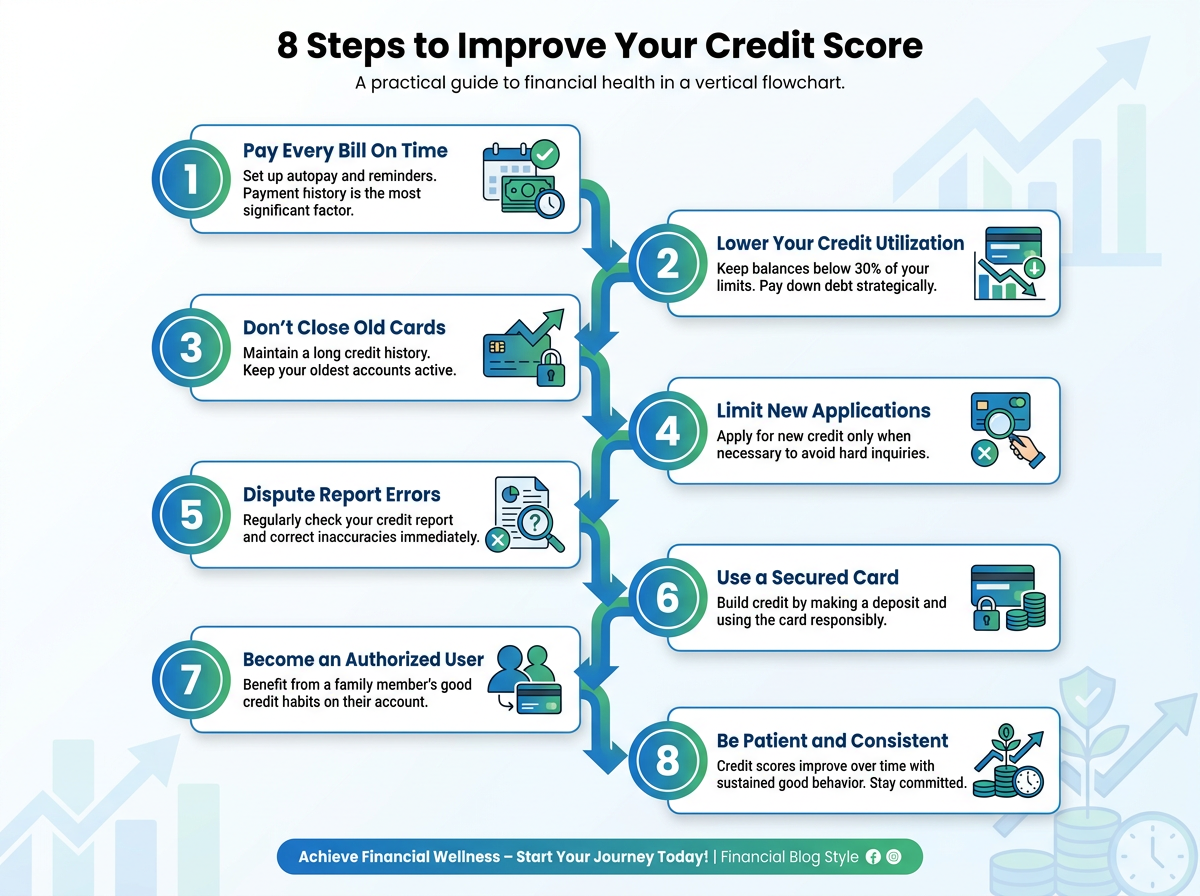
Target the five factors in order of weight, starting with payment history and utilization. There’s no overnight fix, but most people see meaningful movement within three to six months.
Step 1: Pay every bill on time
The most powerful move you can make. Set every credit account to autopay for at least the minimum, then pay the remaining balance manually to avoid interest. Add calendar reminders two days before each due date as a backup.
If you’ve missed a payment recently, get current immediately — the sooner you catch up, the sooner the account stops reporting as late.
Step 2: Lower your credit utilization
The fastest visible gains, because it updates within a single billing cycle. Get under 30%, then push toward 10%.
- Pay down balances aggressively. Target the card with the highest utilization first.
- Pay before the statement closes. The bureaus see the statement balance, so paying early reports a lower number.
- Request a credit limit increase. A higher limit lowers utilization instantly if spending stays flat. Ask whether the request uses a soft pull.
Your next step: Split a large balance into two payments per month to keep the reported figure low.
Step 3: Don’t close old credit cards
Keeping old cards open protects length of credit history and utilization at once. If a card has no annual fee, keep it open indefinitely with a small recurring charge on autopay.
If a card carries an annual fee you no longer want, ask the issuer to downgrade it to a no-fee version rather than closing it. That preserves the account age.
Step 4: Limit new credit applications
Apply only when you genuinely need the credit. When shopping for a mortgage or auto loan, cluster all applications within a two-week window so every scoring model treats them as one. Check whether pre-qualification is available first — it uses a soft inquiry.
Step 5: Dispute errors on your credit report
In the Federal Trade Commission’s 2012 study of credit report accuracy, roughly one in five consumers had an error confirmed and corrected on at least one report, and about one in twenty had an error serious enough to change the credit terms they were offered.
- Pull all three reports from AnnualCreditReport.com.
- Review each line item — accounts, balances, payment status, personal information, and inquiries.
- Flag anything inaccurate, such as a payment marked late that you paid on time or an account that isn’t yours.
- File a dispute with each bureau reporting the error, with supporting documents attached.
- Wait for the investigation — generally 30 days, extending to 45 if you submit additional information mid-process.
Correcting even one wrongly reported late payment can restore points you lost through no fault of your own.
Step 6: Consider a secured card or credit-builder loan
Both help if you have no credit history or are rebuilding. A secured card requires a refundable deposit that becomes your credit limit. A credit-builder loan works in reverse — you make fixed payments that get reported, and receive the funds at the end.
Choose one that reports to all three bureaus, and for a secured card, one that offers a path to graduate to unsecured.
Step 7: Become an authorized user
When a family member adds you to their well-managed card, that account’s positive history can appear on your report. This works only if the primary cardholder pays on time and keeps utilization low, because their behavior now affects you. Confirm the issuer reports authorized users — not all do.
Step 8: Be patient and consistent
Time is the one factor you can’t accelerate. Length of credit history grows only as your accounts age, and recent negative marks lose weight only as months pass. Track the trend line rather than week-to-week swings, which are normal.
Your next step: Keep every good habit running on autopilot and let the calendar do the rest.
How Long Does It Take?
Recent behavior counts most, and old negative marks matter less every month. Focus on what you can change now — utilization and on-time payments — and let time dissolve the rest.
| What you’re fixing | How long | Why |
|---|---|---|
| Utilization | About 1 billing cycle | Your next reported statement reflects it |
| Dispute corrections | 30–45 days | The FCRA investigation window |
| Identity theft block | 4 business days | The bureau does not wait on the furnisher |
| Recovering from one late payment | A few months of clean payments | Recent behavior weighs most; the mark stays 7 years |
| Building a file from scratch | 6 months minimum | FICO needs an account open 6+ months to score you |
| Collections and charge-offs | Up to 7 years + 180 days | From the date of first delinquency |
| Bankruptcy | 7 to 10 years | Chapter 13 is 7, Chapter 7 is 10, from the filing date |
Common Credit Score Myths, Corrected
- "Checking my own score hurts it." False. That’s a soft inquiry and never affects your score. Only hard inquiries from applications have an impact.
- "Carrying a small balance helps my score." False. You never need to carry a balance or pay interest to build credit. What matters is the balance reported when your statement closes.
- "Closing a credit card raises my score." False. It usually lowers it, by shortening your history and reducing available credit.
- "Income is part of my credit score." False. Your salary is not a factor in FICO or VantageScore. Lenders consider income separately during underwriting.
- "Paying off a collection erases it instantly." Mostly false — with one real exception. A paid non-medical collection usually stays on your report, though newer scoring models weigh it far less. But paid medical collections are removed entirely under current bureau policy, and medical collections under $500 are not reported at all.
Frequently Asked Questions
What is a good credit score to buy a house?
Generally 620 or higher for a conventional mortgage, though the best rates go to borrowers at 740 and above. FHA loans allow scores as low as 580 with 3.5% down. One thing worth knowing: mortgage lenders pull older, mortgage-specific FICO versions that can differ from the score in your banking app by 20 points or more in either direction.
What is the average credit score in the United States?
Around 714 as of FICO’s March 2026 release, which places the typical American just inside the Good range. The average stood at 717 in April 2024 and 715 in April 2025 — the recent declines broke a long run of annual increases, driven partly by the resumption of federal student loan delinquency reporting.
Is a 700 credit score good?
Yes. It sits comfortably in the FICO Good range of 670–739, and qualifies you for most loans and credit cards at competitive rates. Pushing into Very Good territory at 740 unlocks the best available terms, particularly on a mortgage.
How often does my credit score update?
Whenever your lenders report new information, typically once a month per account. Because different accounts report on different dates, your score can shift several times throughout the month.
Does my credit score affect renting an apartment?
Yes. Many landlords and property managers run credit checks as part of the application. A low score can mean a denied application, a required co-signer, or a larger security deposit.
What’s the difference between FICO and VantageScore?
Different companies and formulas. FICO, created by Fair Isaac Corporation, is used by about 90% of top lenders. VantageScore was built jointly by the three credit bureaus. Both use the 300–850 scale but weigh factors and draw tier boundaries differently, so the two numbers commonly differ.
Can I get a good credit score with no credit history?
Yes, though it takes time. Start with a secured credit card or credit-builder loan, or become an authorized user on someone else’s well-managed account. FICO needs at least six months of history before it can score you at all.
Will checking my credit score lower it?
No. Checking your own score is a soft inquiry with zero effect. You can check as often as you like. Only hard inquiries, triggered when you apply for new credit, cause a small temporary dip.
Why is my score different on every app I check?
Because you have many scores, not one. Different bureaus hold slightly different data, different models weigh it differently, and different versions of each model are in active use. None of them is wrong. Focus on the report underneath, which feeds all of them.
Take Control of Your Credit Score
A good credit score — a FICO score of 670 or higher — is within reach for nearly anyone willing to follow a consistent plan. You now know the full ranges, the five factors that drive your number, what lenders look for, and the steps to raise it.
The path forward comes down to a few durable habits:
- Pay every bill on time, automated.
- Keep utilization low year-round, not just before you apply.
- Hold onto your oldest accounts.
- Apply for new credit sparingly.
- Check your reports for errors and dispute what’s wrong.
Start with one move today. Pull your free reports from AnnualCreditReport.com, read every line, and note where your score falls in the ranges above. That single action turns an abstract number into a plan you can act on.
Sources
- FICO, credit score ranges, factor weights and national average releases — myfico.com and investors.fico.com
- VantageScore, model documentation and range definitions — vantagescore.com
- Experian, State of Credit and credit utilization guidance — experian.com
- Consumer Financial Protection Bureau, disputes, DTI and medical debt guidance — consumerfinance.gov
- Federal Trade Commission, Report to Congress Under Section 319 of the FACT Act (2012) — ftc.gov
- IdentityTheft.gov — Federal Trade Commission
- AnnualCreditReport.com — the federally authorized source for free reports
Want Help Getting Into a Better Tier?
Strong Credit Report has worked with consumers across California and nationwide since 1999 on disputes, validations, and credit rebuilding. Your first consultation is free, and we’ll tell you honestly whether your situation needs help or whether the steps above are enough on their own.
Schedule a free consultation → · 800-603-8045
Strong Credit Report is a credit repair organization as defined under the Credit Repair Organizations Act. We cannot guarantee specific results or the removal of accurate information. You have the right to dispute inaccurate information yourself at no cost. Nothing on this page is legal or financial advice.