Peter Krakue is the founder of Strong Credit Report in Colton, California, where he has worked in consumer credit since 1999. He writes about dispute procedures, FCRA rights, and credit rebuilding. [Read more about Peter →]
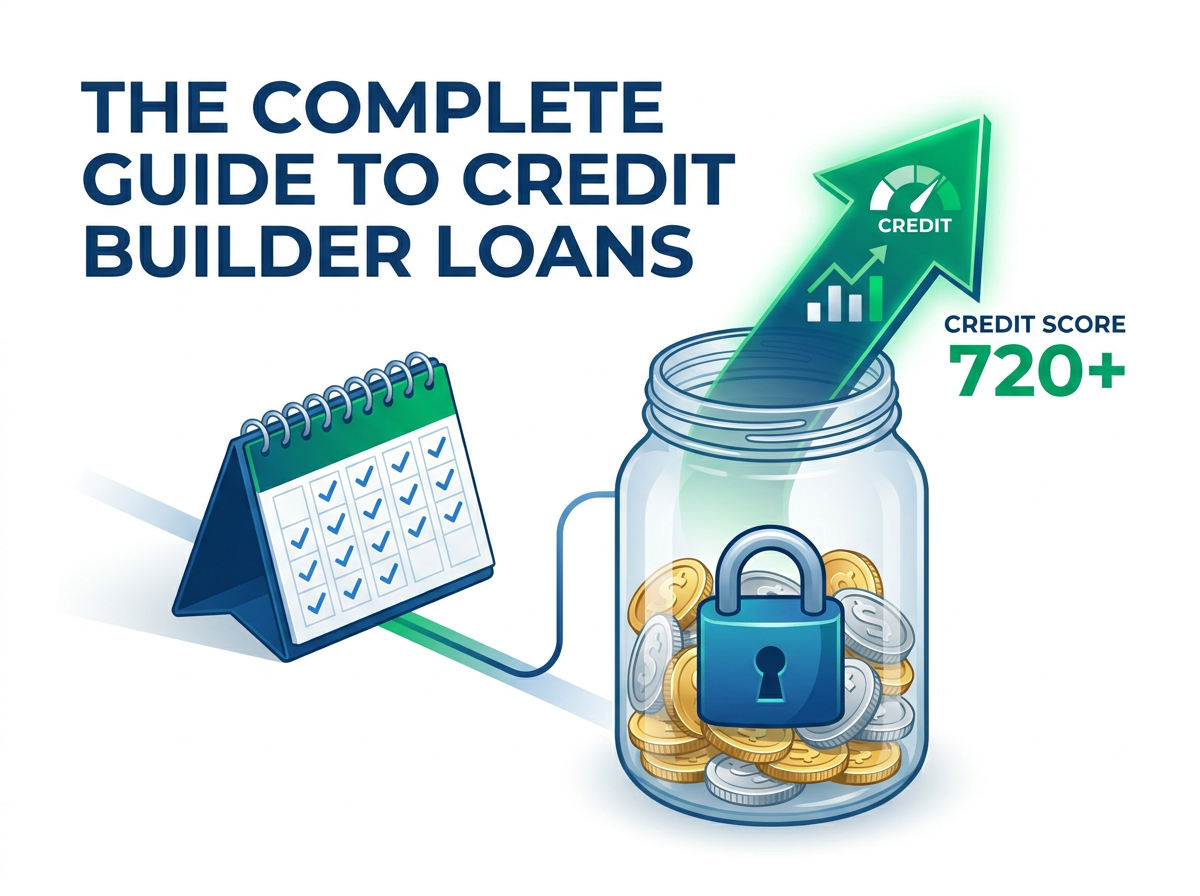
A credit builder loan is a small installment loan designed to help you build a positive payment history rather than hand you cash upfront. The lender holds the loan amount in a locked savings account or certificate of deposit while you make fixed monthly payments, reports those payments to the three major credit bureaus, and releases the money to you once you finish.
Finish the loan and you end up with two things: a stronger credit profile and a small lump sum you saved along the way. Miss payments and you can end up with neither — more on that below, because it matters.
The product solves a frustrating problem. You need credit to get approved for most loans and cards, but you need a track record of borrowing to earn credit in the first place. It’s a locked door with the key sitting on the inside.
Here’s what you’ll learn:
- What a credit builder loan is and how it reports to the bureaus
- The real costs, benefits, and drawbacks before you sign
- Who the research says these loans actually help — and who they can set back
- How to compare lenders and choose the right option
- The exact steps to apply and finish strong
What Is a Credit Builder Loan?
A credit builder loan is a small installment loan built to generate payment history, not to give you money now. It flips the normal loan process backward: instead of receiving cash and paying it back, you make the payments first and collect the funds at the end.
The lender sets aside the loan amount — usually between $300 and $1,000 — in a locked account you can’t touch. You pay it off in fixed monthly installments over a set term, typically 6 to 24 months, according to the Consumer Financial Protection Bureau. Every on-time payment gets reported to Equifax, Experian, and TransUnion. When the last payment clears, the lender unlocks the account and sends you the money.
Think of it as a savings plan that doubles as a credit history generator. You’re not borrowing against your future — you’re paying into a record that proves you’re reliable.
Your next step: Pull your free credit report and check whether you have an active credit score at all. The next sections explain why that answer decides whether this product fits you.
What the Research Actually Says
The CFPB studied credit builder loans directly, and the finding is more nuanced than most articles on this topic admit — nuanced in a way that should shape your decision.
The research found that credit builder loans helped people without existing debt substantially, both in establishing a credit score for those who had none and in raising scores for those who did. But among participants who already carried debt, average scores went slightly down.
The mechanism is intuitive. Adding another monthly obligation to someone already stretched raises the odds of a missed payment somewhere in their file — and a missed payment costs more than the new account gains.
What this means for you
- No credit file and no existing debt? This is close to an ideal use case.
- Already carrying balances you find hard to keep up with? Pay those down first. A credit builder loan added on top is more likely to hurt than help.
- Established credit with years of on-time payments? The marginal benefit is small. Your energy is better spent elsewhere.
Your next step: Before applying, add up your current monthly debt obligations. If adding one more payment would be a strain, that is the answer.
How Credit Builder Loans Work
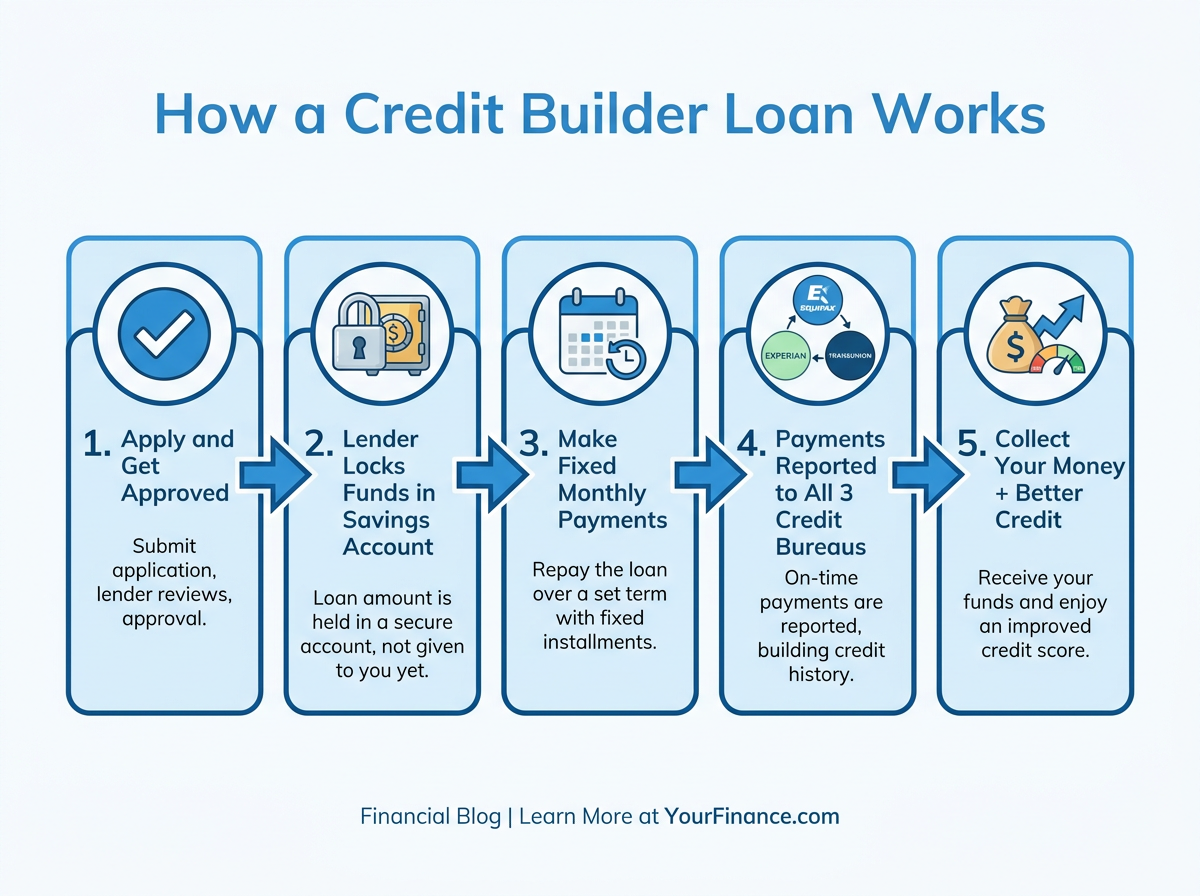
These loans reverse the traditional lending sequence: you pay first and collect the loan amount last. That removes almost all the risk for the lender, which is why approval rarely depends on your credit score.
- Apply and get approved. You pick a loan amount and term. Because the lender holds the money until you finish, credit checks stay minimal — many lenders run only a soft inquiry, which doesn’t affect your score.
- The lender secures the funds. Instead of handing you cash, the lender deposits the full amount into a locked savings account or CD you can’t access yet.
- You make fixed monthly payments. Each covers part of the principal plus interest, and the amount never changes.
- Payments hit all three bureaus. This is the entire point. Every on-time payment adds a positive mark to your Equifax, Experian, and TransUnion reports.
- You collect at the end. Once every payment is made, the lender releases the funds — sometimes minus interest and fees, sometimes with the interest refunded.
Example: You take a $600 credit builder loan over 12 months at a modest rate. Your payment lands around $52 a month. After a year you’ve built 12 straight months of on-time payment history and you receive roughly $600 back — money you effectively saved one payment at a time.
The engine here is payment history, which makes up 35% of your FICO score. A credit builder loan is a controlled, low-stakes way to produce exactly that data.
How the payment structure works
You’re not getting a loan in the usual sense — you’re pre-paying for money the lender holds for you. The funds typically sit in a savings account or certificate of deposit in the lender’s custody until you finish.
Worth asking: where exactly is the money held, and is it insured? With a credit union the funds should be NCUA-insured; with an app-based lender they should sit at an FDIC-insured partner bank. You are handing over money you can’t touch for a year, so ask.
Your next step: Confirm your exact monthly payment, due date, and where the funds are held the moment your loan is approved.
How credit reporting builds your score
Reporting is what turns your payments into a score, and it only works if the lender reports to all three bureaus. A loan that reports to just one delivers a fraction of the benefit, because a lender pulling a different bureau’s report won’t see your progress.
Your next step: Before you sign anything, ask directly: "Do you report to Equifax, Experian, and TransUnion?" Get the answer in writing.
What Happens If You Miss a Payment
The downside deserves more than one line, because it is worse than most readers expect — and it is the whole reason the advice about choosing a sustainable payment matters.
- The late payment reports. The same reporting that builds your score also records the miss, damaging the exact number you are trying to build.
- It hurts more on a thin file. One late mark on a file with three accounts weighs far more heavily than on a file with twenty. The people this product targets are the most exposed to it.
- You may forfeit what you’ve paid in. Depending on the lender, accumulated funds are applied to the outstanding balance rather than returned to you. Read this term specifically.
- Stop entirely and the loan can be charged off. You would end up with a charged-off installment loan on a file you opened this account to improve.
Someone starting from no credit can finish worse off than when they began. That is not an argument against the product — it is an argument for picking a payment you could still make in a bad month, and automating it.
Your next step: Ask the lender exactly what happens to your accumulated funds if you miss payments, and get it in writing.
What Interest and Fees Really Cost
Most lenders charge interest on the loan, plus a possible one-time administrative fee. Two cost structures exist, and the difference is significant:
- Interest-refunded loans. Some lenders return your interest payments at the end, treating it almost like a forced savings contribution. Your real cost drops close to zero.
- Interest-kept loans. Others keep the interest as profit. You still build credit, but the service costs you more.
Advertised APRs commonly run from the single digits at credit unions into the mid-teens and higher at app-based lenders. But APR understates the true cost of this product, because unlike a normal loan you don’t have use of the money while you pay. The number that actually tells you what it costs is simpler: total interest plus all fees, measured against what you get back at the end.
Your next step: Request the full cost breakdown in writing — total interest, every fee, and the amount you receive at the end — so you can compare offers on equal footing.
Credit Builder Loan vs. Secured Credit Card
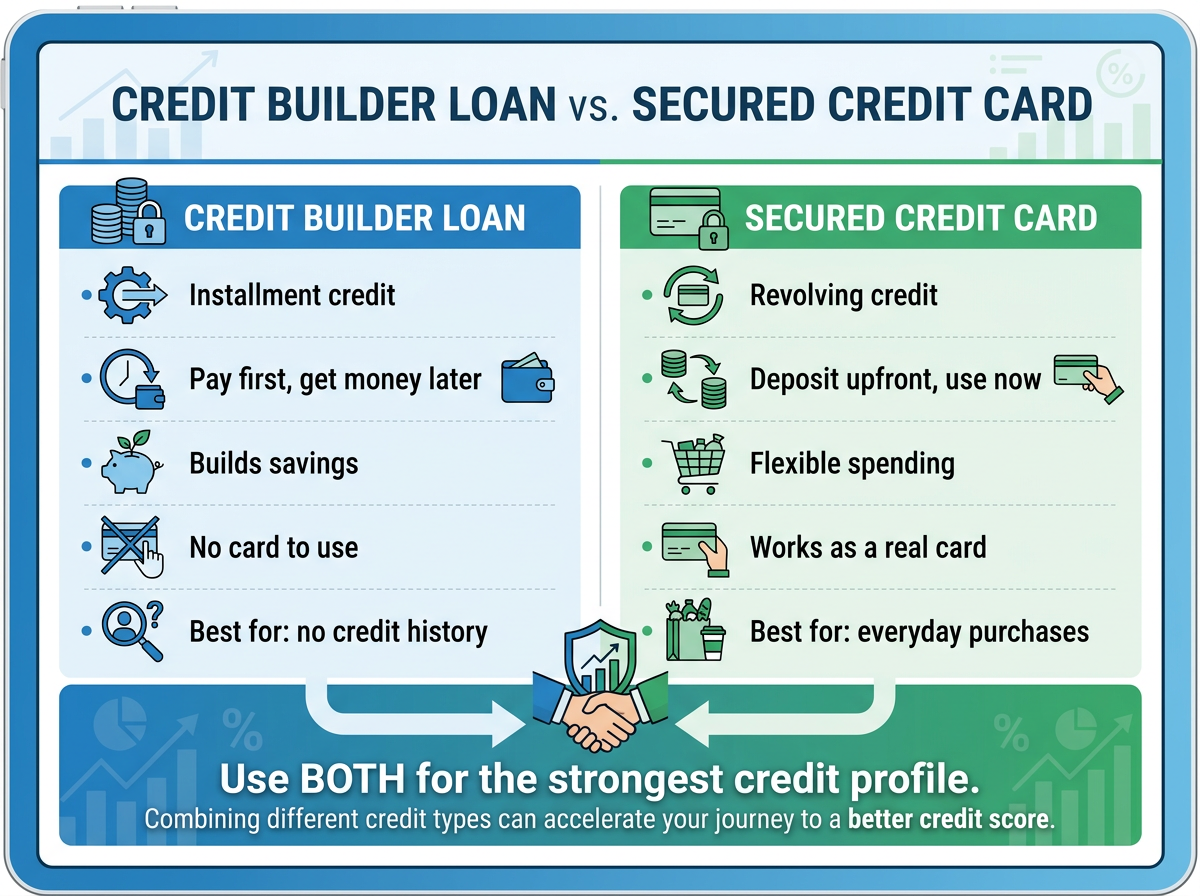
Both help you build credit; they work in opposite directions. A secured credit card requires a refundable deposit that becomes your credit limit, and builds revolving history. A credit builder loan builds installment history — the category that includes auto loans and mortgages.
Key Differences at a Glance
| Credit builder loan | Secured credit card | |
|---|---|---|
| Type of credit built | Installment | Revolving |
| Money upfront | No — you collect at the end | No — your deposit becomes the limit |
| Can you spend it? | No, funds are locked | Yes, it works like a normal card |
| Affects utilization? | No — installment loans are not counted | Yes — keep the balance low |
| Typical cost | Interest, sometimes refunded, plus fees | Annual fee on some cards; interest if you carry a balance |
| Get your money back | At the end of the term | When you close or upgrade the account |
| Ends automatically | Yes, when the term finishes | No — it can become a long-term account |
| Best when | Your file has no installment history | You want a card you can actually use |
Which to choose
- A credit builder loan wins when your file has no installment history — only cards, or nothing at all. It fills a specific gap and improves your credit mix, which is 10% of your FICO score. It also suits anyone who wants to build savings while building credit.
- A secured card wins when you want a payment method you can use day to day, and a refundable deposit you get back when you close or upgrade. It also has a longer useful life — a card can age into a years-old account, while a loan ends when the term does.
- Using both builds a richer file faster, as long as your budget handles both without strain. That last condition is doing real work — see the research section above.
Your next step: Look at your credit report, identify which category you’re missing, and fill that gap first.
Types of Credit Builder Loans
Credit union credit builder loans
The most traditional option, and credit unions dominate this space. A credit union is a member-owned, not-for-profit cooperative, which usually translates to friendlier terms than a big bank. Many keep rates in the single digits and return some or all of the interest at the end. You also get a human being to talk to, which matters when you’re new to credit.
Your next step: Call two or three local credit unions and ask whether they offer a "credit builder" or "share-secured" loan.
Online providers
Fintech companies run the entire process through an app. These platforms shine on convenience — apply in minutes, automate payments, track progress in a dashboard. The tradeoff can be higher fees or interest compared with a credit union, and administrative fees show up more often here.
Your next step: Read the fee schedule line by line on any app-based lender before you commit.
CDFI credit builder loans
A Community Development Financial Institution is a nonprofit or community-focused lender certified by the U.S. Treasury to expand access to affordable financing. These lenders often offer the most affordable terms, because their goal is financial inclusion rather than profit. If cost is your top concern, this category frequently wins outright. Search the U.S. Treasury CDFI Fund locator to find one near you.
Share-secured loans
These use money you already have on deposit as collateral. You borrow against your own savings, pay it back on schedule, and build history while your original savings stay put — often still earning a little interest. Works well if you already have cash sitting idle.
Your next step: Ask your existing bank or credit union whether your current savings can back a share-secured loan.
Pros and Cons
The pros
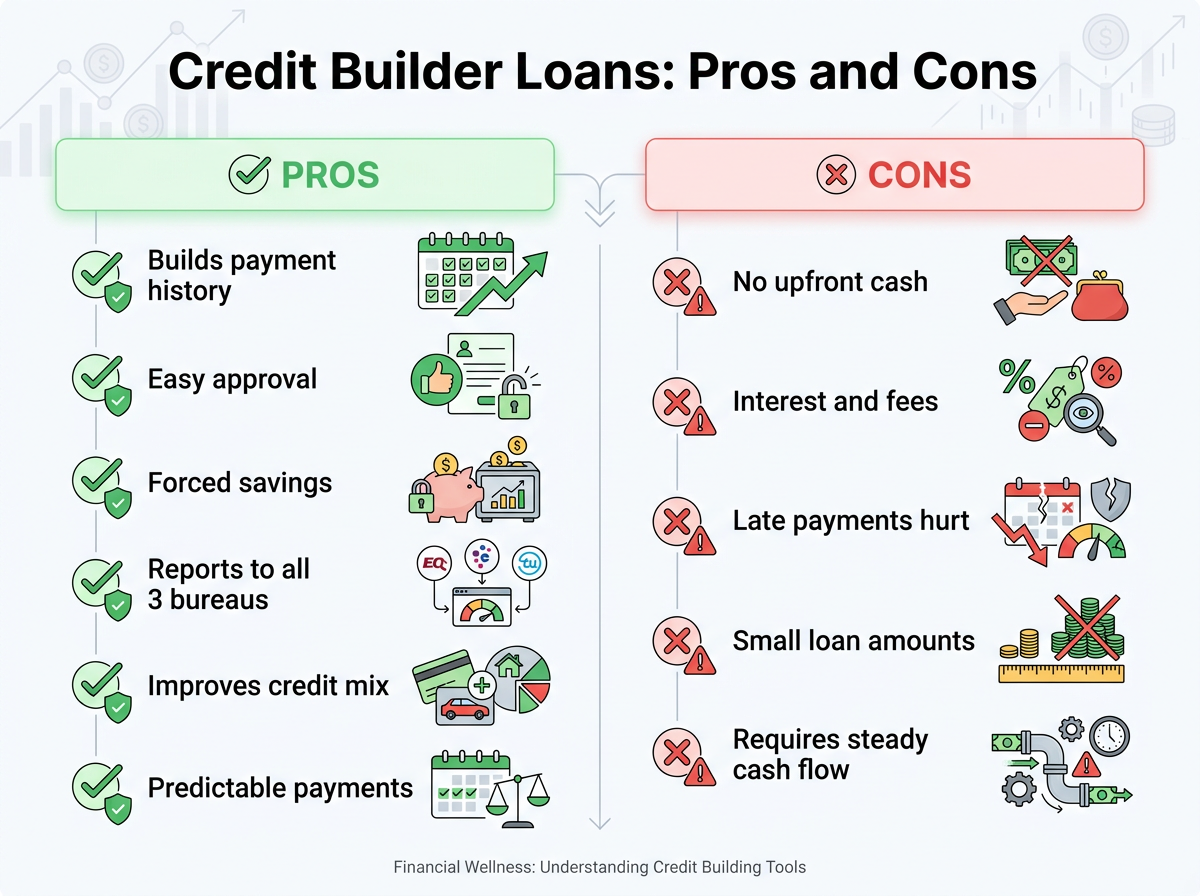
- Builds payment history from scratch. Payment history is 35% of your FICO score, and this loan generates it steadily.
- Easy approval. Because the lender holds the money, your score rarely blocks approval.
- Forced savings. You collect a lump sum at the end — money saved without thinking about it.
- Reports to all three bureaus. The best options do, which maximizes the impact.
- Adds to your credit mix. An installment loan diversifies a file holding only cards.
- Predictable payments. Fixed monthly amounts make budgeting straightforward.
The cons
- No upfront cash. You can’t use this for an emergency — the money stays locked until the end.
- Interest and fees. You pay for the service, and some lenders keep the interest.
- Late payments backfire hard. A miss reports too, and on a thin file it costs more than the account gains. You may also forfeit funds already paid in.
- Small loan amounts. These stay modest by design, so the boost is limited.
- Requires steady cash flow. The research is clear that people already stretched by existing debt often come out behind.
Your next step: Before signing, confirm the lender reports to all three bureaus. A loan that reports to only one delivers a fraction of the benefit.
Who Should Get a Credit Builder Loan?
You’re a strong candidate if you fit one of these profiles and you have room in your budget for the payment:
- You have no credit history. New borrowers, recent graduates, and first-time credit users need a starting record. FICO needs at least one account open six months or more before it can score you.
- You’re new to the United States. Immigrants often arrive with no domestic credit file even with a strong financial history abroad.
- You’re rebuilding after a setback. Bankruptcy, collections, or a rough stretch leaves a damaged file that needs fresh positive data.
- You want to diversify your credit mix. If your report shows only credit cards, an installment loan fills the gap.
- You struggle to save. The forced-savings structure builds a cash cushion while it builds your score.
Skip it if you already hold a healthy file with years of on-time payments, or if you’re currently stretched by existing debt — for that second group the research suggests the loan is more likely to hurt than help.
Your next step: Check whether you currently have a credit score at AnnualCreditReport.com.
How to Choose the Best Credit Builder Loan
The best one reports to all three bureaus, charges low total cost, and fits your monthly budget. Compare offers against these criteria.
| What to check | Why it matters | How to verify |
|---|---|---|
| Three-bureau reporting | Reporting to one wastes most of the benefit | Ask directly and get it in writing before applying |
| Total cost | A low monthly payment can hide high fees | Add interest plus every fee; compare against what you get back |
| Interest refund | Some lenders return it, dropping real cost near zero | Ask whether interest is refunded at the end |
| Where funds are held | You cannot touch this money for months | Confirm FDIC or NCUA insurance |
| Missed-payment terms | You may forfeit funds already paid in | Ask what happens to accumulated funds on default |
| Early-payoff terms | Finishing early can cut your reported history | Ask before you prepay, not after |
| Reputation | Tells you whether the lender delivers | CFPB complaint database and the BBB |
Read recent, specific customer reviews rather than star ratings alone, and check the lender’s standing with the CFPB complaint database and the Better Business Bureau.
Your next step: Line up three lenders against this list and choose the one that reports to all three bureaus at the lowest total cost.
How to Apply for a Credit Builder Loan
Applying takes about 15 minutes once you’ve chosen a lender. The process stays deliberately simple, because these loans are built for people at the very start.
- Check your credit first. Pull your free reports from AnnualCreditReport.com and confirm whether you have a score. Scan for errors while you’re there — a wrongly reported late payment can drag down a score you’re trying to build.
- Set a budget you can sustain. Decide the monthly payment you can cover without strain, then work backward to a loan amount and term. A smaller payment you never miss beats a larger one you struggle with.
- Compare lenders side by side. Use the checklist above on at least three options.
- Gather your documents. A government-issued photo ID, your Social Security number or ITIN, proof of income such as a pay stub, and a bank account for payments.
- Set up autopay immediately. Automate every payment the moment the loan is active. Add a calendar reminder two days before each due date as a backup.
On security: you’ll share sensitive details during any credit application. Apply only through lenders you’ve verified, and confirm the site uses encryption — look for "https" and a padlock in the address bar — before entering your Social Security number.
Your next step: Once your loan is active, set a monthly reminder to check your score and watch the trend line.
How to Build Credit Faster Alongside Your Loan
A credit builder loan is one tool. Pairing it with a few habits builds credit faster.
- Pay every bill on time. Payment history is 35% of your score. Automate everything.
- Keep credit card balances low. Utilization is the largest component of amounts owed, which is 30% of your score. Under 30%, and under 10% for the strongest effect.
- Become an authorized user. A family member with a long, clean card can add you, and that history can appear on your report.
- Keep old accounts open. Length of credit history is 15%, so hold onto your oldest card.
- Apply for new credit sparingly. Each hard inquiry can shave off a few points, so space applications out.
On-time payments plus low balances handle 65% of what drives your score. Nail those two and everything else compounds on top.
Common Mistakes to Avoid
- Choosing a lender that reports to only one bureau. You lose most of the benefit. Confirm all three before you sign.
- Missing a payment. A single late payment can drop a young score sharply and erase months of progress. Autopay prevents it.
- Picking a payment you can’t sustain. Overreaching leads to missed payments. Choose a comfortable amount, even a small one.
- Taking one on while already stretched. The research says this is where the product backfires. Pay down existing balances first.
- Ignoring the total cost. A low monthly payment can hide high fees. Compare total cost, not the monthly figure.
- Closing the loan too early. Some structures cut your reported history if you finish ahead of schedule, and you may forfeit an interest rebate. Ask before you prepay.
- Skipping the follow-up check. Errors happen. Verify every payment was reported correctly to all three bureaus.
Your next step: After your final payment, pull a fresh report and confirm the completed loan shows a clean, on-time history.
Frequently Asked Questions
What is a credit builder loan?
A small installment loan designed to help you build credit history. Instead of receiving the money upfront, the lender holds the funds in a locked account while you make fixed monthly payments. Those payments get reported to the credit bureaus, and you receive the money once the loan is paid off.
Do credit builder loans really help your credit?
They can, when the lender reports your on-time payments to all three bureaus — but it depends on your situation. Research from the CFPB found they help people without existing debt substantially, while people already carrying debt saw average scores dip slightly. If adding another monthly payment would strain your budget, pay down what you have first.
Can I get a credit builder loan with bad credit?
Yes. Because the lender holds the funds until repayment is complete, approval requirements are much easier than traditional loans, and many lenders use only a soft credit inquiry.
How much does a credit builder loan cost?
You pay interest and possibly an administrative fee. Advertised APRs run from the single digits at credit unions into the mid-teens and higher at app-based lenders — but APR understates the real cost here, since you do not have use of the money while you pay. Compare total interest plus fees against what you get back at the end. Some lenders refund the interest, which drops the real cost close to zero.
What happens if I miss a payment?
The late payment gets reported, which damages the score you are building — and on a thin file it does proportionally more harm. Depending on the lender you may also forfeit funds already paid in, and stopping entirely can result in a charged-off loan. Ask your lender exactly what happens before you sign, and automate the payment.
Is a credit builder loan better than a secured credit card?
Not necessarily — they build different things. A credit builder loan builds installment history; a secured card builds revolving history. The loan ends when the term does, while a card can age into a long-standing account. If your budget handles both, using them together strengthens your profile faster.
How long before it improves my credit?
You may see movement within one to three months after your first payment is reported. The full benefit builds over the entire term, since each payment adds to the history lenders want to see.
Where can I get one?
Local credit unions, community banks, Community Development Financial Institutions, and online fintech lenders. Credit unions and CDFIs often offer the lowest costs; online lenders offer the most convenience. The CDFI Fund locator on the Treasury website will find certified community lenders near you.
Is the money I pay in insured?
It should be. At a credit union the funds should be NCUA-insured, and an app-based lender should hold them at an FDIC-insured partner bank. Ask — you are handing over money you cannot access for months.
Should I pay it off early?
Usually not. Finishing early ends the reporting, so you build fewer months of payment history, and some lenders forfeit the interest rebate on early payoff. Ask about the early-payoff terms before you decide.
Your First Step Toward Stronger Credit
A credit builder loan turns the credit paradox — needing credit to get credit — into a clear path forward. Small fixed payments build a positive history across all three bureaus, and you walk away with both a stronger score and a lump sum of savings.
The formula is simple, and each piece matters:
- Confirm the lender reports to all three bureaus.
- Check that you are not already stretched by existing debt.
- Pick a payment you could still make in a bad month.
- Automate it and never miss a due date.
- Pull a fresh report at the end and confirm it reported clean.
Start today. Pull your free reports at AnnualCreditReport.com to see where you stand, then compare three lenders using the checklist above. One small loan, paid on time, is often all it takes to open the first door.
Sources
- Consumer Financial Protection Bureau, credit builder loan research and consumer guidance — consumerfinance.gov
- FICO, credit score factors and minimum scoring criteria — myfico.com
- Experian, credit utilization guidance — experian.com
- U.S. Treasury CDFI Fund, certified lender locator — cdfifund.gov
- Better Business Bureau — bbb.org
- AnnualCreditReport.com — the federally authorized source for free reports
Building Credit From Scratch?
Strong Credit Report has worked with consumers across California and nationwide since 1999 on disputes, validations, and credit rebuilding. Your first consultation is free, and we’ll tell you honestly whether a credit builder loan fits your situation — or whether cleaning up what’s already on your report should come first.
Schedule a free consultation → · 800-603-8045
Strong Credit Report is a credit repair organization as defined under the Credit Repair Organizations Act. We cannot guarantee specific results or the removal of accurate information. You have the right to dispute inaccurate information yourself at no cost. We are not a lender and nothing on this page is legal or financial advice.